The Critical Reality of System Failure
Across the globe, public safety leaders are facing a difficult truth. The primary physical systems that once supported emergency response are no longer unconditionally reliable. When critical infrastructure like power grids, cellular networks, broadband connections, and landline systems degrade or fail, communication becomes the final, essential instrument of control.
This is the premise of modern crisis leadership. The true foundation of national resilience is no longer static physical infrastructure, but trusted and uninterrupted communication. When public safety leaders lose the ability to send a clear message, they also lose the ability to effectively manage crises.
From Local Events to a National Resilience Challenge
Recent events on both sides of the Atlantic show how fragile our systems have become. In Yorkshire, UK, relentless rainfall caused rivers to surge and engulf entire districts. Power grids shut down and cellular towers failed. Emergency phone lines flooded with calls while responders lost visibility. Yet, in the chaos, alerts from BlackBerry® AtHoc® still reached residents by SMS, email, desktop notifications, and mobile apps. Satellite pathways carried messages where primary communication networks had already collapsed, allowing alerts to continue flowing through the channels that remained available.
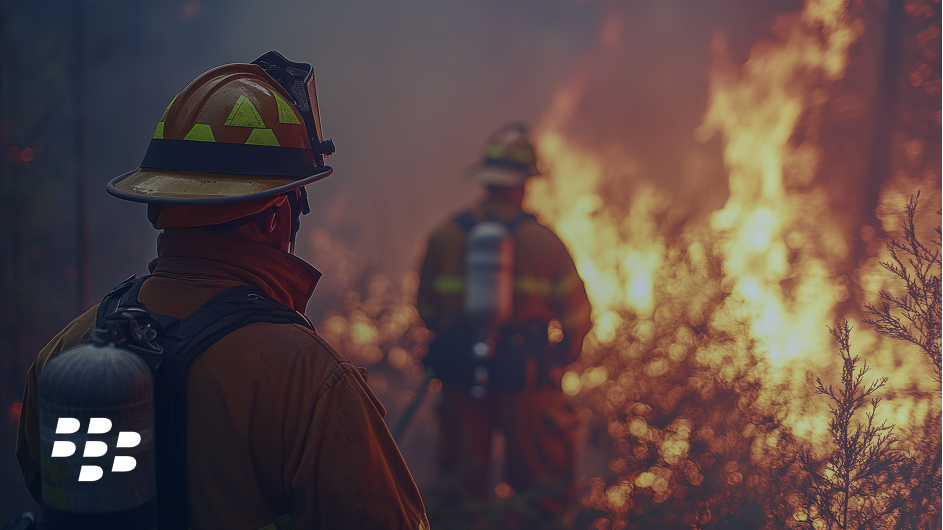
In British Columbia, Canada, a rapidly spreading wildfire pulled in municipal responders, provincial and federal agencies, Indigenous leaders, and utilities operators. Historically, these groups operated on separate systems, but with AtHoc they shared a unified operational picture. Residents received highly targeted evacuation alerts while field teams sent geo-targeted video directly into command centers, and acknowledgment tracking provided real-time accountability. Even as smoke severely impacted wireless networks, critical information continued to flow despite widespread disruption.
These moments reveal a larger pattern, showing that extreme weather events are no longer outliers, but an ongoing challenge to national resilience itself.
Addressing the Modern Infrastructure Fragility Problem
These events expose a deep flaw in traditional response protocols, highlighting why standard communication tools are no longer adequate.
Legacy emergency communication tools were designed for predictable, localized failures. They assumed the presence of stable power, functioning towers, and reliable broadband. Today, these assumptions no longer hold up against unprecedented climate change and natural disasters..
When networks degrade, communication becomes fragmented, messages are delayed, and vital information is lost. Command centers lose visibility into who is safe, who is responding, and who is missing. Traditional single-channel systems cannot carry the weight of modern emergencies, and this is where AtHoc is different. It is engineered to maintain operational continuity under degraded conditions and to preserve communication when physical networks falter by automatically routing messages across whichever communication channels remain operational.
The Coordination Multiplier: Beyond Simple Alerts
The ability to preserve communication under stress is vital, but modern response also requires advanced coordination.
Communication during a disaster is not limited to simple alerts. It is the coordination layer that allows hundreds of micro-decisions to occur simultaneously. Emergency teams must synchronize evacuations, manage medical transfers, reroute traffic, and dispatch equipment, all while sharing real-time intelligence. This can only be effective when every participant can see, understand, and react to the same information.
AtHoc provides this coordination through multi-modal delivery across SMS, voice, email, desktop alerts, radio, and satellite. Its dashboard shows message delivery, acknowledgments, and team locations. Two-way communication allows responders to share field conditions instantly. Integrations with emergency management tools, access control systems, and other operational platforms used by public agencies create a unified view that spans jurisdictions and agencies.
Coordination is the multiplier that protects lives, and AtHoc makes that coordination possible.
Lessons Learned: The Imperative for Resilience
The experiences in the UK and Canada give clear direction for what public safety agencies must prioritize going forward.
The UK flooding showed how quickly local communication infrastructure can suffer partial failure. The Canadian wildfire demonstrated the complexity of cross-jurisdictional response. Both events illustrate that the speed and scope of modern disaster now exceeds the capacity of legacy communication systems.
These are no longer isolated events but warnings of things to come. Disasters outpace traditional communications systems and now demand more stakeholders and real-time information than ever. As extreme weather intensifies, partial infrastructure failures will become more common. Instead of disappearing, critical systems will simply falter as primary communication channels slow down or go dark. In those moments, platforms like AtHoc keep information flowing by shifting to whichever networks remain, whether satellite, radio, landline, or surviving IP routes.
What Communication Resilience Means for Public Safety
For emergency managers, the stakes are high: a delayed message can cost lives, a missed acknowledgment can create dangerous blind spots, and a broken communication chain can escalate an incident into a regional crisis. Modern public safety agencies must treat crisis communication as critical infrastructure. It must be secure, interoperable, and engineered to survive partial failure.
At the strategic level, nations and agencies that build communication resilience into their infrastructure and tools will be better positioned to lead in a crisis. This means designing continuity into both the systems they manage and the technologies they deploy. Those that do not will face grave, yet preventable consequences.
Why BlackBerry AtHoc Is the Solution
BlackBerry AtHoc delivers the resilient communications backbone modern crisis response demands. Its multi-channel, redundant routing ensures critical messages reach the right people through whatever networks remain operational. A real-time command dashboard gives leaders clear visibility into delivery status, acknowledgments, and unfolding field conditions. Two-way communication turns every responder into a live sensor, feeding ground intelligence directly back to command. Seamless integrations cut through organizational silos, bringing fragmented agencies into a synchronized response. And throughout it all, the AtHoc platform’s government-grade security model safeguards sensitive information, even when infrastructure is strained or degraded.
Final Reflection
The next decade of crisis management will not be defined by who has the most equipment or the strongest infrastructure, but by who can maintain trusted communication continuity when primary systems fail. After four decades of supporting governments and critical infrastructure, BlackBerry understands this reality. The urgency and stakes may have changed, but the mission remains the same: when infrastructure fails and communication must endure, leaders turn to BlackBerry AtHoc.